
June 2025 marked 19 years since Terra Global’s founding. Since 2006, the company has been dedicated to deploying private sector capital to nature-based solutions (NbS) to generate fair risk-adjusted returns to investors while delivering a new carbon revenue stream to developing country governments and communities.
As a mission-driven investment manager and carbon project developer, Terra Global has built a distinctive model that integrates technical expertise, trusted local partnerships, and long-term climate finance outcomes. Nearly two decades later, this collaborative community-led, science-based model is more essential than ever as the world works urgently to keep global warming below 1.5°C and ensure a just transition to net zero.
Innovating to Deploy Capital at Scale
The need for scalable, high-integrity climate finance is only now becoming universally recognized. Terra Global has been a pioneer in this space from its beginning, creating new ways for private capital to support climate action at the local level.
Terra Global has helped shape NbS climate finance through breakthrough innovations and scalable models for investment:
- 2010: Launched Terra Global Investment Management, one of the first investment managers to integrate expertise in both NbS climate finance investments and carbon project development
- 2011: Secured the world’s first political risk insurance for a REDD+ project
- 2014: Deployed our first climate finance investment in Malawi’s Kulera REDD+ Program, which is now fully funded by carbon revenues and impacting more than 300,000 people
- 2015: Supported the development of our first jurisdictional REDD+ program document for Congo Brazzaville to receive results-based based payments from the World Bank’s Carbon Fund
- 2018: Traded some of the first NbS carbon credits under Colombia’s tax and credit system
- 2021: Formalized processes and tools to develop bankability and fulfil investment readiness requirements to meet institutional and corporate investor requirements
- 2023: Launched the Terra Bella – Nature-based Solutions Carbon Fund to scale climate finance with integrity and durability
These milestones reflect Terra Global’s model for scalable climate finance, linking capital to impact where it matters most.
What makes this work transformative is not only its scale, but also its structure. Projects are designed in partnership with local communities, ensuring long-term ownership and benefit allocation structures that support durability, people, and ecosystems.
Key examples of this approach include:
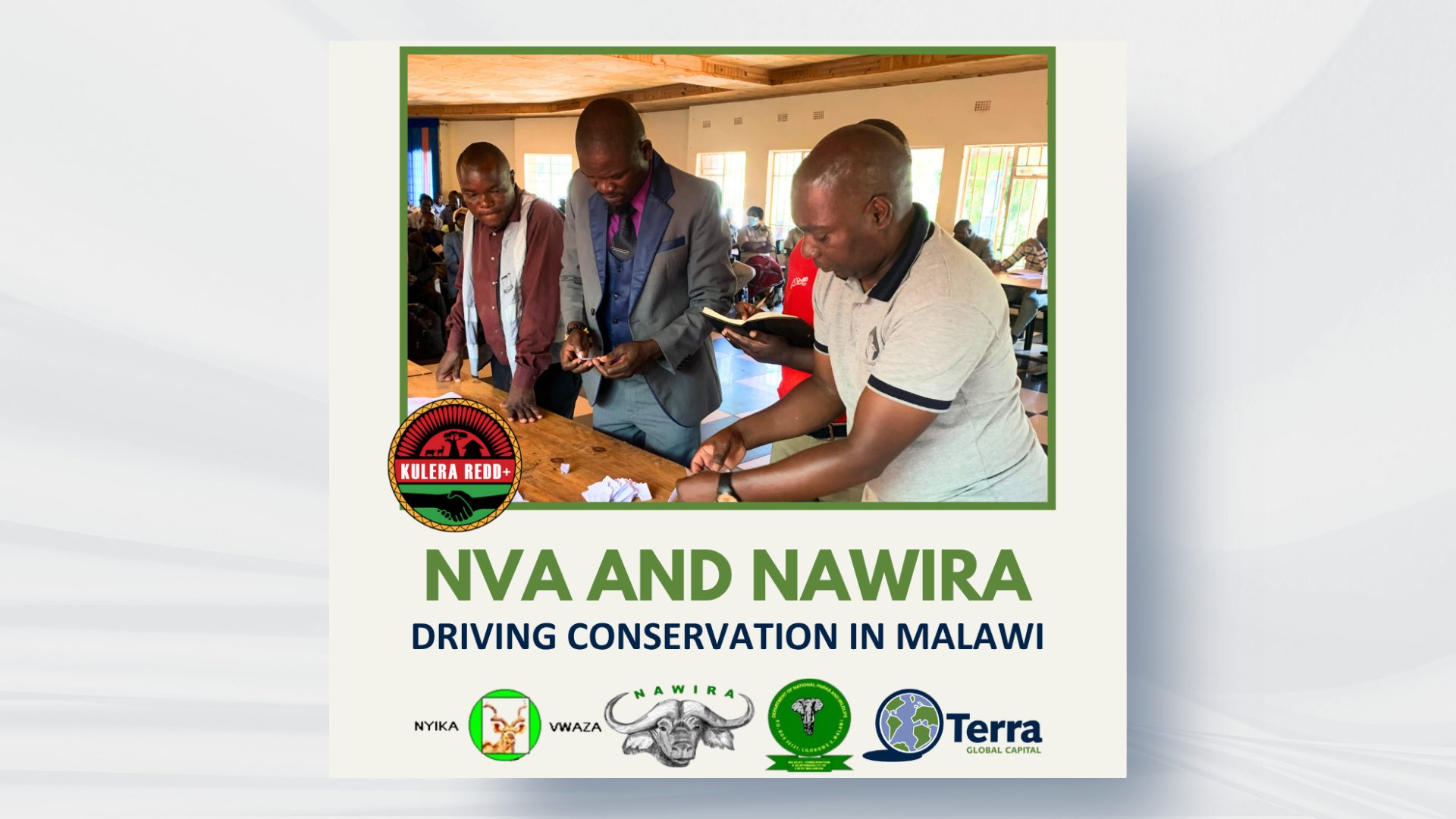
By 2014, the company had brought this model into practice through the Kulera Landscape REDD+ Program for Co-Managed Protected Areas, in Malawi, directing climate finance to one of the world’s most vulnerable landscapes and countries. More than a decade later, the program continues to generate impact, with over USD 23 million in carbon revenue and 95 percent of that reinvested into community-led activities. These include improved cookstoves, agroforestry, forest patrols, conservation agriculture, small livestock pass-on programs and sustainable livelihoods focused on honey, macadamia, and other enterprises.
In 2023, to leverage Terra Global’s years of climate finance experience and innovation globally, the company launched the Terra Bella – Nature-based Solutions Carbon Fund (TB–NbS Fund). Its first investment, completed in 2024, demonstrated that it is possible to meet the needs of both institutional investors and local communities. By combining investment and rural development expertise, the Terra Global ensures capital is not only deployed for investors’ gains but is also aligned to deliver long-term climate and social impact.
Building Efficiency and Transparency Through Science and Technology
Credibility is the foundation of effective climate finance where accuracy and efficiency are at the core of measuring its climate impact and associated co-benefits. Terra Global has been an innovator in developing GHG quantification methods and have invested significantly in the tools and systems required to ensure that emissions reductions and removals are measured, verified, and reported with transparency, accuracy, and efficiency.
Terra Global has led Science-Based Innovation to Enable Measurable Climate Action:
- 2010 – 2013: Authored the world’s first REDD+ methodology for Avoided Unplanned Deforestation and Degradation (AUDD REDD+), creating a new pathway for forest carbon quantification
- 2010: Published the first comprehensive Practical Guide to Nested REDD+, establishing the foundation for integrating project activities into national emissions accounting systems
- 2014: Achieved the world’s first Triple Gold validation and verification under the Climate, Community & Biodiversity (CCB) Standards, demonstrating excellence in environmental and social co-benefits
- 2015: Authored VT0005: Tool for Measuring Aboveground Live Forest Biomass Using Remote Sensing, to provide scalable, cost-effective estimates of forest carbon stocks using remotely sensed data
- 2015: Developed our first Jurisdictional Nested REDD+ program document for Congo-Brazzaville, enabling results-based payments from the World Bank’s Carbon Fund
- 2016: Authored VT0006: Tool for Calculating LULC Transitions and Deforestation Rates Using Incomplete Remote Sensing Images, enabling reliable deforestation and degradation estimates in high-cloud or data-poor regions
- 2017: Issued the world’s first carbon credits from sustainable rice cultivation, verified by the American Carbon Registry and transacted with Microsoft—marking a global innovation in agricultural methane reduction
- 2019: Completed the world’s first Verra Jurisdictional and Nested REDD+ (JNR) baseline for the Bago Region of Myanmar, using Terra Global’s proprietary classification and risk allocation tools
- 2021: Started the technical carbon development work under the VCS and CCB and monetization of credits for four agroforestry projects
- 2024: Together with the COCOMACIA an Afro-Colombian Community Council and CODECHOCO, the government agency, we have completed a Verra JNR baseline and risk mapping for the Choco department covering 5.5 million hectares under 97% persistent cloud cover and ex-post monitoring of deforestation and degradation
Terra Global deploys technology and software systems to improve data integrity, reduce transaction costs, increase accuracy, and improve management across all levels of implementation and for the quantification of carbon credits and their co-benefits.
Examples of the application of proprietary and off-the-shelf tools and technology include:
- Proprietary land-use classification software (TerraCover©) that incorporates machine learning to generate high-resolution baselines, including deforestation and degradation;
- Proprietary land use change software (TerraChange©) used to create spatially explicit jurisdiction baselines and allocations to nested projects;
- Proprietary baseline modeling tool for ARR projects under VM0047 uses geospatial analysis and statistical modeling to identify control plots and simulate counterfactual forest growth, enabling robust, auditable, and project-specific dynamic baselines
- Mobile data collection, which was created and first tested for a household survey of 1,900 homes in Malawi led by local project coordinators;
- Deployed 100% community-based patrolling using SMART to ensure accountability and early detection;
- Terralytics platform, which supports: i) document and data management for audits and investor due diligence, ii) nested activity manager for geospatially monitoring, and iii) collaborative classification for incorporating local expertise.
These innovations are about more than technology. They are about building trust and efficiency into the fabric of carbon finance and the GHG quantification. By combining advanced tools with local engagement, Terra Global delivers climate results that are measurable, verifiable, and credible at scale.
This work is made possible by a team of 37 dedicated professionals and a global network of collaborators. From the forests of the Congo and Colombia to the rice fields of Myanmar and the community lands of Malawi, progress is grounded in long-term partnerships with governments, NGOs, and communities.
Implementing and Structuring Finance for the Just Transition
At the core of Terra Global’s approach is a belief that climate finance must be just, inclusive, and community-rooted. Mobilizing private capital for mitigation is not enough; how and where that capital flows is just as critical.
The company’s model is built to meet these needs. By working directly with local partners and embedding principles of inclusion, transparency, and economic viability, Terra Global ensures climate finance reaches those who are both most vulnerable to climate change and most essential to climate action.
Terra Global’s investments are deployed in line with the nine good-practice criteria and related indicators defined in the company’s 2024 thought leadership paper, “Delivering a Just Transition Through Nature-based Solutions: Practitioner’s Guide to Creating a Just Transition with NbS Investments”:
1. Foster inclusive dialogue and consultation: Programs are co-designed with governments, NGOs, and communities
2. Prioritize vulnerable landscapes and populations: Capital is directed to regions with high climate risk and social vulnerability
3. Promote gender equity and representation: Women’s participation and leadership are actively supported
4. Design solutions rooted in local context: Projects reflect local laws, land tenure, and governance systems
5. Create decent jobs and livelihood opportunities: Livelihoods are built through agroforestry, conservation enterprises, and climate resilience
6. Support skills and income during transition: Programs include training, capacity building, and transitional income pathways
7. Ensure that climate action enhances equity: Benefit-sharing structures are embedded in all projects
8. Develop economically viable NbS programs: Projects are grounded in business models that support long-term sustainability
9. Adaptively manage based on evidence and feedback: Continuous monitoring and learning inform real-time improvements
These principles shape how Terra Global builds partnerships, designs programs, and manages capital. They ensure that nature-based solutions deliver not only emissions reductions, but also equitable benefit sharing, opportunity, and resilience.
The TB–NbS Fund, launched in 2023, is a dedicated investment vehicle for deploying private capital to high-integrity NbS programs in developing countries. Its first investment, completed in 2024, validated the viability Terra Global’s approach that delivers returns while empowering local communities.
The need for high-integrity, scalable climate finance has never been more urgent. Terra Global’s mission, to mobilize private capital with integrity, equity, and scale, is more essential than ever.
Terra Global expresses deep gratitude to its partners, collaborators, and team for 19 years of shared progress. The next chapter begins with renewed purpose and #PassionAndPersistence for people and the planet.