

Introduction
As the Zanzibar Community Restoration Project advances, recent fieldwork highlights the critical role of on-the-ground capacity-building in delivering high integrity, community-led forest conservation and restoration. The Project is funded by the WALD – Innovation Facility, managed by IUCN and funded by German Cooperation via KfW, which aims to scale ambitious approaches that attract private climate finance, mitigate climate change, and produce key biodiversity and community benefits.
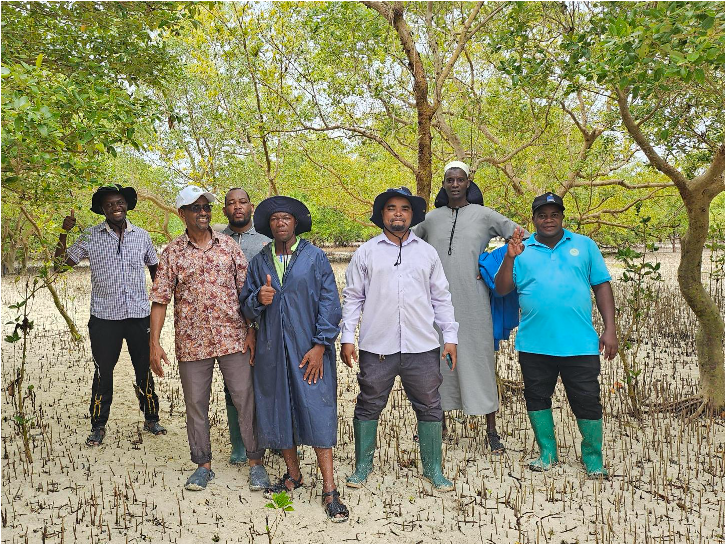
During a recent field visit, Erica Meta Smith, Managing Director of Technical Development at Terra Global, led a series of biomass measurement trainings designed to support the Project’s establishment of baseline conditions in mangroves and coral rag forests targeted for restoration. Working closely with Terra’s local project coordinator Ismail Omary, as well as our local partner Jumuiya ya Uhifadhi Misitu ya Jamii Zanzibar (JUMIJAZA), the Department of Forestry and Non-Renewable Natural Resources (DFNR), and supported by the participating communities, the visit focused on equipping local teams with the technical skills to conduct field data collection to meet rigorous GHG market standards.
Leveraging Local and International Expertise
The success of this training combined local and international expertise to operationalize locally relevant standard operating procedures (SOPs) for biomass sampling within mangrove and coral rag forests.
The team conducted both classroom-based and field-based trainings, covering Zanzibar’s specific forest types, species composition, and local conditions. The work took place during Ramadan, where schedules were adjusted to respect cultural practices.
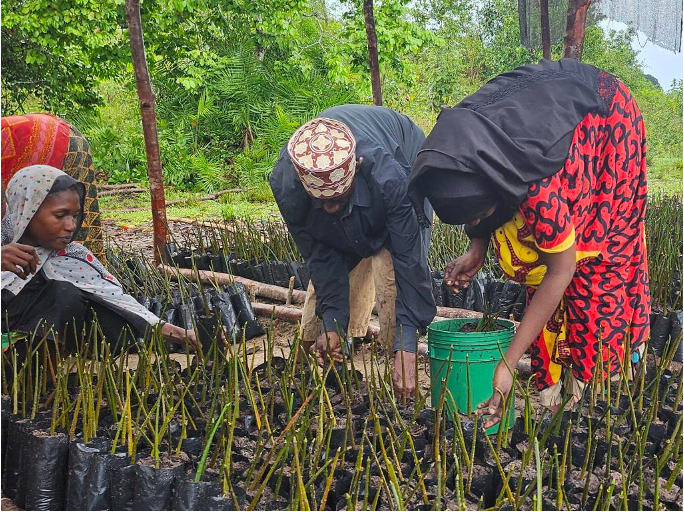
In parallel with the trainings, Erica and the team visited several community nurseries already in development, where seedlings are germinating in preparation for mangrove planting. Field assessments were also conducted to establish boundary demarcation for mangrove restoration and assisted natural regeneration of coral rag. The visit underscored the importance of combining technical expertise with local knowledge. Community members working alongside JUMIJAZA contributed insight into local tree species, forest conditions, and land use practices, strengthening both the accuracy of measurements and the relevance of the SOPs being applied.
Women’s Participation
In Unguja, the biomass measurement team was largely women-led, highlighting strong women participation in the restoration and in the field-based technical work. Additionally, many of the personnel from the DFNR, responsible for carrying out the demarcation, were women, showing strong inclusion in the government’s technical teams that support both measurement and boundary-setting activities. “This [was] [a] women led, women dominated biomass measurement team, which was really exciting to see,” Erica shared. In Zanzibar, this Project “supports women in carrying out key technical field activities.” This demonstrates women’s leadership, economic empowerment, and equitable access to Project benefits.
About the Zanzibar Restoration Project
The Zanzibar Community Restoration Project is restoring 3,300 hectares of mangroves and coral rag forests across 16 community managed areas on Unguja and Pemba islands. The implementing partner, JUMIJAZA, is an umbrella NGO supporting the Shehia Conservation Councils who are the governance bodies for the registered community-managed forest areas (CoFMAs). This includes tree planting, monitoring and patrolling restored forest areas, and implementation of livelihoods activities at the local level. The Project reduces pressure on forest resources and enhances community resilience through the promotion of conservation-linked activities. The restoration of the mangrove and coral rag forests improves ecological integrity, supports the conservation of threatened species, and reinforces long-term sustainable forest stewardship.
This Zanzibar Community Restoration Project is supported by IUCN’s WALD Innovation Facility, funded by the German Cooperation via KfW Development Bank. The contents of this article are the sole responsibility of Terra Global and do not necessarily reflect the views of IUCN, the German Cooperation or KfW.